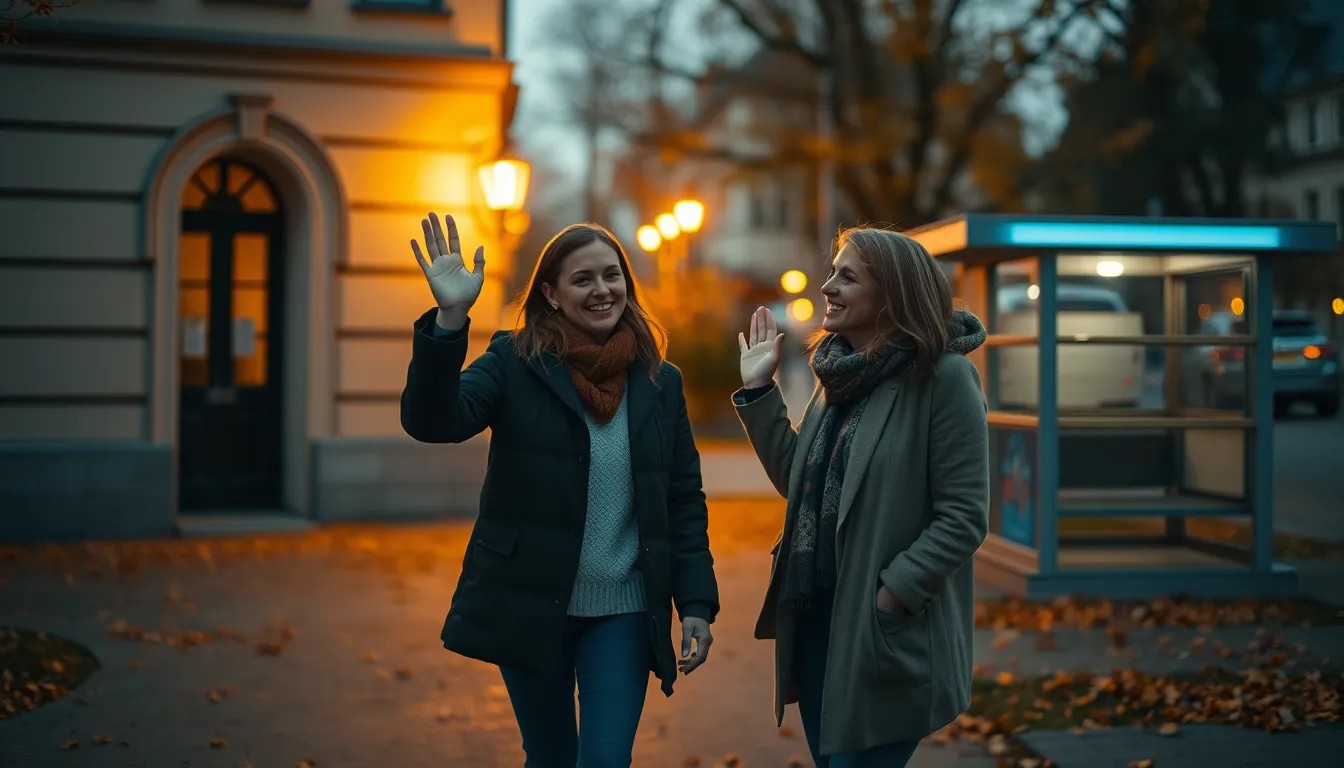
Estonians keep hellos brief, but farewells can be surprisingly warm — a parting often stacks two or three wishes: Nägemist, head õhtut, hoia end! Wishing Head nädalavahetust! on a Friday is almost expected, and a kind Hoia end! ("take care") lands especially well in the dark winter months.
By the end you can say goodbye in Estonian at any level of warmth — Nägemist, Head aega, Nägemiseni — and wish someone a good day, evening or weekend with one easy pattern.
End of the day — everyone heads home. Listen for all the different goodbyes.
Tap any word for its meaning. Tap a word's Kuula lauset to hear that sentence in the chosen voice.
Tund on läbi. „Head aega!“ ütleb õpetaja. „Nägemist! Head päeva!“ vastavad tudengid.
Anna ja Jaan lähevad koos. „Kas sa tuled homme?“ küsib Jaan. „Jah! Homseni!“ ütleb Anna.
Bussipeatuses on Mari. „Tere-tere! Ja juba head aega,“ naerab ta. „Head nädalavahetust!“ ütleb Anna.
Buss tuleb. „Nägemiseni! Hoia end!“ ütleb Mari. „Aitäh, sina ka!“
The class is over. “Goodbye!” says the teacher. “Bye! Have a good day!” answer the students.
Anna and Jaan walk together. “Are you coming tomorrow?” asks Jaan. “Yes! See you tomorrow!” says Anna.
Mari is at the bus stop. “Hello-hello! And already goodbye,” she laughs. “Have a good weekend!” says Anna.
The bus comes. “See you! Take care!” says Mari. “Thanks, you too!”
Key words from the story. Tap the speaker to hear each one.
| Estonian | Say it like | English |
|---|---|---|
| Head aega! | head AE-ga | goodbye |
| Nägemist! | NAE-ge-mist | see you, bye (casual) |
| Nägemiseni! | NAE-ge-mi-se-ni | until we meet (bit formal) |
| Homseni! | HOM-se-ni | see you tomorrow |
| Head päeva! | head PAE-va | have a good day |
| Head õhtut! | head UHH-tut | have a good evening |
| Head nädalavahetust! | head NAE-da-la-va-he-tust | have a good weekend |
| Hoia end! | HOI-a end | take care! |
| Ole terve! | O-le TER-ve | take care / cheers (casual) |
| homme | HOM-me | tomorrow |
| tund | tund | lesson, class, hour |
| läbi | LAE-bi | over, finished |
| buss | buss | bus |
One idea to hold on to — the rest of the lesson builds on it.
Nägemist! — casual "see you". Head aega! — the standard goodbye. Nägemiseni! — a touch more formal, "until we meet".
And one lovely, endlessly reusable pattern — Head + [time]! = "Have a good ___!": Head päeva! · Head õhtut! · Head nädalavahetust!
Two things to take away. First, a small set of farewells to recognise and choose by warmth. Second, one productive pattern you can reuse forever: Head + a time word = a good wish.
| Wish | Estonian | When |
|---|---|---|
| Have a good day | Head päeva! | leaving in the daytime |
| Have a good evening | Head õhtut! | leaving in the evening |
| Have a good weekend | Head nädalavahetust! | on a Friday |
| See you tomorrow | Homseni! | you'll meet tomorrow |
The farewell words, casual → formal:
- 1Nägemist! — casual "see you" (friends, every day).
- 2Head aega! — the all-purpose standard goodbye.
- 3Nägemiseni! / Kohtumiseni! — "until we meet" — a little more formal or heartfelt.
Two short exchanges. Tap the speaker on any line and say it back.
Recognise it: tap the option that fits.
Type the missing word, then check.
It's Friday evening and you're leaving your Estonian class. Write (or say aloud) a short 4-line goodbye: say bye to the teacher, wish them a good weekend, and arrange to see them again.
Mix a farewell (Nägemist! / Head aega!) with a good wish (Head nädalavahetust!) and a Homseni! or Nägemiseni!
Pairing a farewell with a good wish — Head aega! Head nädalavahetust! — is exactly how Estonians round off the week. Warm, short, done.
- say goodbye at any warmth: Nägemist · Head aega · Nägemiseni
- wish well with Head + time: Head päeva / õhtut / nädalavahetust
- arrange to meet: Homseni! · add Hoia end! (take care)
Quick check
These come back tomorrow, in 3 days and in a week — in your flashcards and review email.