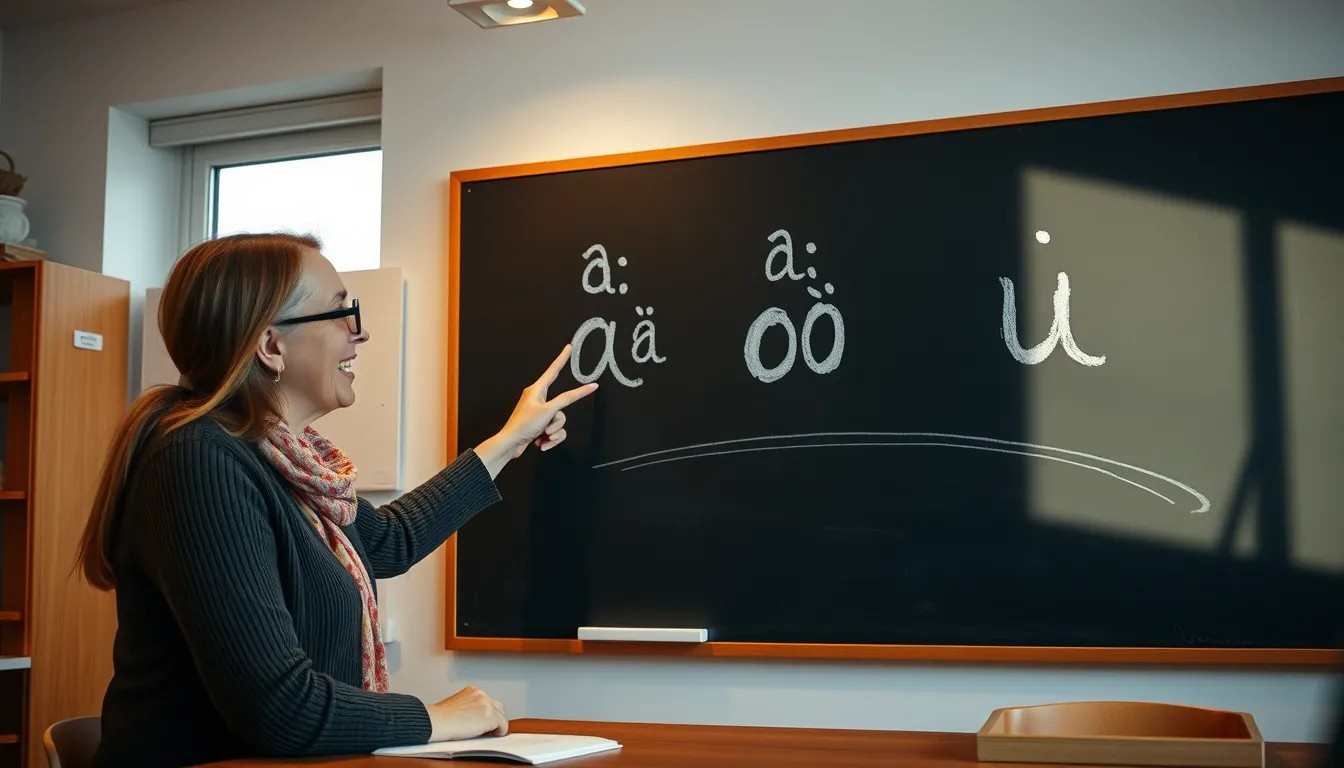
These four letters give Estonian its unmistakable look and sound. Õ is the famous one — a vowel most languages don't have, and a quiet point of national pride; the word õnn (happiness) is a lovely one to practise it with. Master the four and your Estonian immediately sounds far more native.
By the end you can hear and say Estonian's four special letters — õ, ä, ö, ü — each with its own fixed sound, and you'll know why uks (door) and üks (one) must never be mixed up.
Anna practises the four special sounds with her teacher. Listen for õ, ä, ö, ü — and the pair that trips everyone up.
Tap any word for its meaning. Tap a word's Kuula lauset to hear that sentence in the chosen voice.
Täna harjutab Anna nelja eri tähte. Õpetaja ütleb: „Kuula hoolega: õ, ä, ö, ü.“ „Need tähed on eesti keeles väga tähtsad.“ Anna proovib: „Õ… ä… ö… ü…“
„Õ on nagu „õun“,“ seletab õpetaja. „Ä on nagu „käsi“, ö on nagu „öö“, ü on nagu „üks“.“ „Vaata: uks ja üks ei ole sama sõna!“ Anna naerab: „Uks on „door“, üks on „one“!“
„Nüüd ütle: üks, käsi, öö.“ Anna kordab aeglaselt ja siis kiiremini. „Suurepärane! Su hääldus läheb paremaks,“ ütleb õpetaja. Anna on rõõmus: täpitähed ei ole enam rasked.
Today Anna practises the four special letters. The teacher says: “Listen carefully: õ, ä, ö, ü.” “These letters are very important in Estonian.” Anna tries: “Õ… ä… ö… ü…”
“Õ is like ‘õun' (apple),” explains the teacher. “Ä is like ‘käsi' (hand), ö is like ‘öö' (night), ü is like ‘üks' (one).” “Look: uks and üks are not the same word!” Anna laughs: “Uks is ‘door', üks is ‘one'!”
“Now say: üks, käsi, öö.” Anna repeats slowly and then faster. “Excellent! Your pronunciation is getting better,” says the teacher. Anna is happy: the special letters aren't hard any more.
Key words from the story. Tap the speaker to hear each one.
| Estonian | Say it like | English |
|---|---|---|
| õ | a back 'uh', lips relaxed | the letter õ (no English twin) |
| ä | 'a' in “cat” | the letter ä |
| ö | 'u' in “fur” | the letter ö |
| ü | 'ee' with rounded lips | the letter ü |
| õun | UH-un | apple |
| käsi | KAE-si | hand |
| öö | öö (like “fur”, held) | night |
| üks | üks | one |
| uks | uks | door |
| hääldus | HAEAEL-dus | pronunciation |
| kuulama | KUU-la-ma | to listen |
| aeglaselt | AEG-la-selt | slowly |
| kiiremini | KII-re-mi-ni | faster, more quickly |
One idea to hold on to — the rest of the lesson builds on it.
õ — a back vowel with no English twin (as in õun, apple).
ä — like a in "cat" (käsi, hand).
ö — like u in "fur" (öö, night).
ü — like French u / German ü (üks, one).
They are not decorated a/o/u — they're separate letters, and swapping them changes the word: uks (door) ≠ üks (one).
The hardest is õ — there's no English equivalent, so it's worth a moment. The other three you can borrow from English, French or German.
| Letter | Trick to make it | Example |
|---|---|---|
| õ | say 'o' but pull your tongue back and un-round your lips | õun — apple |
| ä | the 'a' in “cat”, nice and open | käsi — hand |
| ö | the 'u' in “fur” / German schön | öö — night |
| ü | say 'ee', then round your lips tightly | üks — one |
Two habits that help:
- 1Always pronounce the dots/tail — ü ≠ u, ä ≠ a, ö ≠ o, õ ≠ o.
- 2Hold each vowel steady — Estonian vowels are "pure"; they don't glide like English ones.
Two short exchanges. Tap the speaker on any line and say it back.
Recognise it: tap the option that fits.
Type the missing word, then check.
Say the four special letters out loud, each with its anchor word. Then write the four anchor words — mind the dots and the tail.
Out loud: õ nagu õun, ä nagu käsi, ö nagu öö, ü nagu üks.
Anchoring each sound to a known word (õun, käsi, öö, üks) means you can find it again in the middle of a sentence.
- hear and tell apart õ ä ö ü
- give an anchor word for each: õun · käsi · öö · üks
- know the dots/tail change meaning: uks (door) ≠ üks (one)
Quick check
These come back tomorrow, in 3 days and in a week — in your flashcards and review email.